
Author: kevitivity
A wedding
My youngest sister got married this weekend. It was a beautiful ceremony in Palos Verdes Estates California.
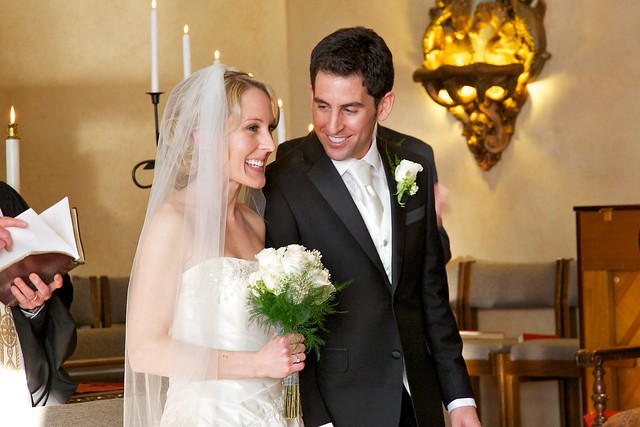
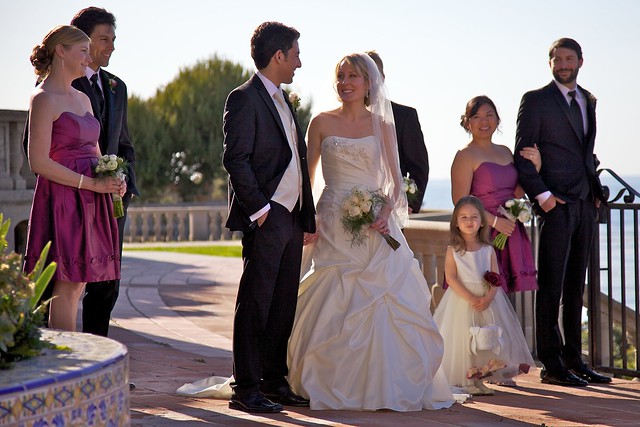

My sister also had a professional Photog – his work is very impressive. You can check him out at http://pickerillcreative.com/
Trader Sam’s Enchanted Bar – Krakatoa Punch
When I heard Disneyland added a Tiki themed bar to the Disney hotel in Anaheim California I just had to go and check it out. This is the souvenir cup and light cube that comes with the Krakatoa Punch cocktail. The cup itself is very high quality, and made by Tiki Farm. The light cube is sealed, with a non-replaceable battery. It looks like you can purchase the cube here for about $4.00.
The cocktail itself was weak, expensive, and tasted mostly of pineapple juice…
Miette’s first Christmas
Cute doggie + family Christmas gathering = great photos…


Bridged networking with KVM / qemu
First off, I cannot recommend Peter Membrey’s “The Definitive Guide to CentOS” enough. If you’re a new admin or just want to make sure
you’re doing it right, this is the book to get.
Some of the scientists I support at work rely on software that requires an old, defunct version of Ubuntu (6, Edgy). And because it’s starting to get hard to find hardware that will still run that old version of Linux I’m now using virtualization technology (KVM and CentOS 5.7). These instructions should work with Redhat and it’s derivatives.
The tricky part of all this (for me at least) was setting up the network. I need the virtual Ubuntu machine to appear on the network as if it were a separate host with a public IP, rather then behind a NAT router. Thus I used a bridged network setup. The method bellow worked for me, but it’s not necessarily the only or best way to accomplish this… I’ve tested these procedures on CentOS 5.7 and 6.2. Before we get started, you need to add two CentOS packages via the yum command: bridge-utils and tunctl.
Step One: Create a virtual network bridge (br0)
This particular server has one physical interface (eth0). What you have to do is create a virtual network bridge (br0), give it your public IP/GATEWAY/etc, and then add the physical interface to the bridge…
First, backup /etc/sysconfig/network-scripts/ifcfg-eth0 to another directory. My original ifcfg-eth0 looked like this
# Broadcom Corporation NetXtreme BCM5722 Gigabit Ethernet PCI Express

DEVICE=eth0

BOOTPROTO=static

BROADCAST=192.168.0.255

HWADDR=B8:AC:6F:99:36:95

IPADDR=192.168.0.60

NETMASK=255.255.255.0

NETWORK=192.168.0.0

ONBOOT=yes
Now copy /etc/sysconfig/network-scripts/ifcfg-eth0 to /etc/sysconfig/network-scripts/ifcfg-br0. Edit the two files so that they look like so… notice that the IP and GATEWAY are now in ifcfg-br0 and not ifcfg-eth0.
/etc/sysconfig/network-scripts/ifcfg-br0 (I had do add my GATEWAY as well as copy over IPADDR)
DEVICE="br0"

ONBOOT=yes

TYPE=Bridge

BOOTPROTO=static

IPADDR=192.168.0.60

GATEWAY=192.168.10.1

DELAY=0
/etc/sysconfig/network-scripts/ifcfg-eth0
DEVICE="eth0"

ONBOOT=yes

TYPE=Ethernet

HWADDR=B8:AC:6F:99:36:95

BRIDGE=br0
Now reboot, or simply restart the network via the /etc/init.d/network script. If all is working properly, your host will still have a functioning network connection. You’re half way done…
Step two: Create a virtual, TUN/TAP interface (tap0) for your first VM.
To create the tap0 interface:
/usr/sbin/tunctl -b
Bring up the new interface:
/sbin/ifconfig tap0 up
Now add tap0 to the bridge so it has access to your physical network:
/usr/sbin/brctl addif br0 tap0
Thats it!
Now, when you install or start your qemu vm, just make sure your “-net” option looks like the one bellow so that your vm has access to the tap0 interface. Most examples I’ve found on the net do these last steps in a script that then launches qemu…
#!/bin/sh

/usr/sbin/tunctl -b

/sbin/ifconfig tap0 up

/usr/sbin/brctl addif br0 tap0

qemu-system-x86_64 -hda disk.img  -boot d  -m 1024 -net nic -net tap,ifname=tap0,script=no -no-acpi
A Wedding


My younger brother was married today. It was a wonderful wedding and I wish them both many years of happiness. Congratulation guys!
Argus C3 35mm

This was my Dad’s, who used it in the 60s while in Peru working for the Peace Corps . A camera like this was also used as a prop in Harry Potter & the Chamber of Secrets. This thing is heavy and built like a tank.
The Argus C3 was made from 1939 to 1966 by Argus Cameras, Inc. of Ann Arbor, MI. “The camera was the best-selling 35mm camera in the world for nearly three decades, and helped popularize the 35mm format. Due to its shape, size, and weight, it is commonly referred to as “The Brick” by photographers (in Japan its nickname translates as “The Lunchbox”). The most famous 20th century photographer who used it was Tony Vaccaro, who employed this model during World War II (see under Famous Patrons in this article).” – wikipedia
Camping in Big Sur California – Limekiln State Park
My close friend Bear organized a three night camping trip to Limekiln State Park in Big Sur California.

The campground is beautiful – extremely lush and green – nestled in forest canyon along with a rushing stream and massive coastal redwood trees.

This area was originally used as a lime quarry for concrete back in the late 1800’s. Three large stone and iron kilns are still on the property and accessible via a very short but beautiful hike.

In general, Big Sur is a wonderful place for photography. Thanks Bear, it was a blast.
I Like Turtles

Saw this sign while driving through the Mojave. I also came across this one warning of Burros
Spring Poppy

Spring is here and the flowers are in full bloom. This photo was taken at the Huntington Library in Pasadena California, which is a fantastic place to shoot if you are looking for interesting and varied flowers to photograph.
 Kevin Stanchfield